


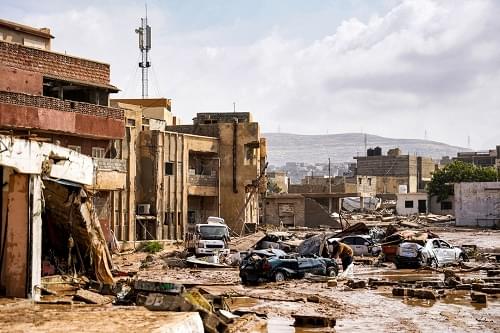
The aftermath of an earthquake in Morocco and flooding in Libya has shown up the state of the two nations.
Not one but two disasters have struck in recent days – the earthquake in Morocco and devastating flooding in Libya.
At least 2,900 people are known to have died in the 6.8-magnitude earthquake that struck in Morocco’s High Atlas mountains a week ago, and the authorities say the death toll will rise.
Three days later, on 11 September, intense flooding in Libya led to the collapse of two dams that unleashed a torrent of mud and water into Derna, destroying large parts of the eastern city.
On Friday morning, the Libyan Red Crescent said the number of people who had died in the city had risen to 11,000 and was expected to rise further as rescue teams arrived and helped to retrieve more bodies from the mud. Officials said 30,000 people were missing.
The full scale of the disaster may be far greater, as few international aid agencies or news reporters have been able to reach the flood-hit area. This area is controlled not by the government in Tripoli but by a rival warlord.
Morocco and Libya may be geographically relatively close to each other – just a 2,000km hop across Algeria – but they could not be two more different countries. This has had a huge impact on their ability to respond to the disasters.
Libya is a failed – or semi-failed – state that has been caught up in a protracted civil war since 2011, which has obviously had a massive impact on the country’s infrastructure and social cohesion.
“Morocco, on the other hand, is a functioning modern state. The place works – Marrakech, Tangier, Rabat are all modern cities. Ordinary people have been mobilised on a mass scale, and there is a very strong sense of nationhood.”
The World Meteorological Organization said the huge death toll could have been avoided if Libya, a failed state for more than a decade, had a functioning weather agency. “They could have issued warnings.” “The emergency management authorities would have been able to carry out evacuation of the people. And we could have avoided most of the human casualties.”
Libya’s attorney general has been asked by senior politicians to launch an urgent inquiry “to hold accountable everyone who made a mistake or neglected by abstaining or taking actions that resulted in the collapse of the city’s dams”.
International aid only started to reach Derna on Wednesday afternoon, two days after the catastrophe. It may now be too late to save lives. The mayor, Abdulmenam al-Ghaithi, said: “We actually need teams specialised in recovering bodies.”
A search team director, Lutfi al-Misrati, told Al Jazeera: “I fear that the city will be infected with an epidemic due to the large number of bodies under the rubble and in the water. We need bags for the bodies.”
Another official said the number of dead people could increase significantly as the “sea is constantly dumping dozens of bodies”.
The role of Morocco’s king
While it is much easier to get international aid to Morocco, the government has been criticised for not accepting more assistance. So far only search and rescue teams from the UK, Qatar, Spain and the United Arab Emirates have been allowed in. Offers of help from the US, Tunisia, Turkey, Taiwan and, significantly, the former colonial power France have not been accepted.
The king of Morocco, Mohammed VI, has refused support from Paris, which ruled Morocco as a colony between 1912 and 1956, after years of fraught relations. It led the French president, Emmanuel Macron, to post a video saying: “There is the possibility of supplying humanitarian aid directly. It is clearly up to his majesty the king and the Moroccan government, in a manner entirely befitting their sovereignty, to organise international aid.”
Despite the king’s apparent dislike of the French government, he spends much of the year in a 10-bedroom, €80m mansion near the Eiffel Tower, complete with a swimming pool, spa and hair salon.