


By Dania Abdelfattah
NABLUS (Al Raqeeb) – In a southern village near Nablus, the story of a media student exemplifies the daily hardships ingrained in the lives of many university students. Kawthar Awwad, a senior student at An-Najah National University, has long dreamt of an outstanding academic future and worked diligently to excel in her studies. Yet today, she finds herself shackled by the presence of Israeli checkpoints, which obstruct her journey to university, transforming her fundamental right to education into a perilous and exhausting daily ordeal.
“In the past, I woke up each day with renewed hope, eagerly preparing for my lectures and planning my time between studying and socializing with friends,” Awwad recalls wistfully, reflecting on days when checkpoints weren’t a dominating factor in her life. “Now, my life revolves around a daily message on Telegram: ‘Awarta checkpoint open inbound, heavy traffic outbound.’ Checkpoints have become my daily nightmare. My focus has shifted from exams and lectures to worrying about whether I’ll reach university on time or return home safely.”
Under normal circumstances, Awwad’s journey to the Awarta checkpoint, east of Nablus, takes around 40 minutes, followed by an hour-long commute to Nablus. However, during closures, this commute can extend to over five hours, with hours spent waiting anxiously at the checkpoints. “I feel sad, afraid, and anxious every single day. I never know if I’ll be allowed to cross, face delays, or endure humiliating searches. I constantly worry about whether my phone will be searched or if I’ll be arbitrarily detained,” she explains.
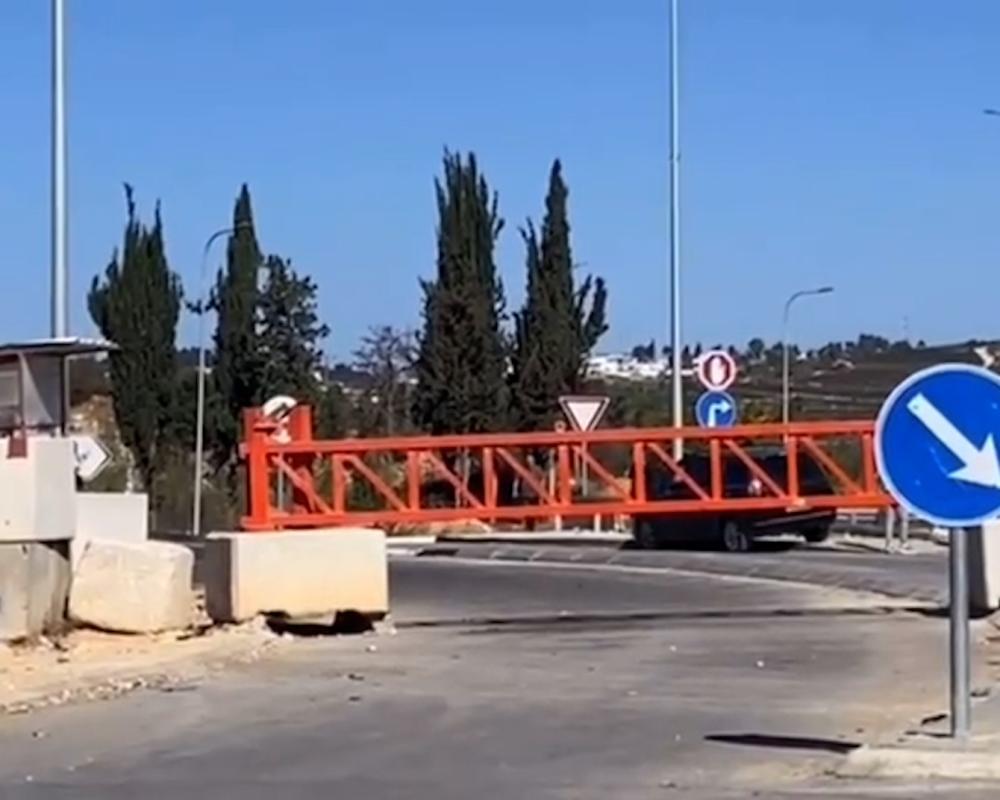
Around Nablus, the largest city in the northern West Bank, Israeli forces enforce their grip with 10 permanent military checkpoints and numerous mobile ones. Additionally, over 20 iron gates isolate and seal off dozens of villages in the area.
These military checkpoints, which exert absolute control over Palestinian movement, pose significant risks to commuters. The Israeli occupation forces frequently close bypass roads and secondary routes between towns and villages, forcing residents to rely solely on checkpoints. These checkpoints, which effectively function as ambushes, expose Palestinians to the constant risk of detention or even death, turning their daily commutes into dangerous expeditions.
Awwad recalls a particularly harrowing experience at the Al-Murabba’a checkpoint, south of Nablus: “Once, soldiers stopped the bus I was on and forced us to disembark under the pretext of a security inspection. The inspection lasted an hour, during which they searched our bags and phones, keeping us standing with their weapons pointed at us. It was a terrifying experience where I felt utterly powerless and feared for my life.”
These severe conditions have not only disrupted Awwad’s daily routine but have also significantly impacted her academic performance and mental health. “I’ve taken many exams without proper focus because of delays. At times, I’ve had to postpone exams or miss them altogether. I no longer have time to study essential materials, let alone explore additional resources to develop myself. My academic life has been reduced to whatever the occupation allows,” she laments.
Once an active participant in student activities, workshops, and events, Awwad has now withdrawn from these engagements due to fears associated with travel. “I used to dream of taking advantage of every opportunity to develop myself, but now everything feels out of reach because of the checkpoints,” she explains.
Under the pretext of security, Israel continues to impose collective punishment on Palestinians in the West Bank, including over 800 permanent military checkpoints and additional temporary ones. These checkpoints range from stone and dirt barriers to approximately 150 iron gates, isolating and restricting Palestinian communities. Reports indicate that these measures aim to “fragment, isolate, monitor, and exert control over Palestinian areas rather than ensuring the security of the occupation.”
For Palestinians, particularly those commuting along main roads, checkpoints dominate daily life. Updates about checkpoint conditions are shared on social media platforms or private groups, where a red indicator signifies a closed checkpoint, while green indicates that it is open and passable.
According to the latest statistics from the Palestinian Commission Against the Wall and Settlements, Israel operates 872 checkpoints and military gates in the West Bank. Of these, 145 were installed after Oct. 7, 2023, primarily to tighten control and surveillance rather than ensure security.
Despite these challenges, Awwad finds strength in her family’s unwavering support, though they live in constant fear for her safety. “My mother often tells me, ‘Your safety is more important than any lecture.’ This support gives me strength, but it doesn’t ease the daily pain and humiliation we endure,” she shares
Financial Strains Another Burden on Students
The challenges faced by Kawthar Awwad are not limited to the security and psychological pressures imposed by military checkpoints; they also extend to significant financial burdens caused by skyrocketing transportation costs. With the steep increase in fares, students now find themselves paying double or even triple the amount they used to. “We used to pay 9 shekels to reach the university. Now, we’re paying 15 or even 20 shekels, and sometimes up to 25 shekels if we’re forced to take alternative routes or private vehicles due to road closures,” Kawthar explained.
She elaborates that this rise translates into an additional daily expense of over 50 shekels, amounting to more than 1,000 shekels per month—a heavy financial burden for students who often rely on families with limited income. “Instead of focusing on my studies, I now find myself constantly worrying about how to cover transportation costs and manage my monthly budget between travel expenses and other necessities,” she said.
These financial pressures add another layer of hardship for Palestinian students, intertwining economic crises with security challenges. This complex reality transforms the pursuit of education into a burden that demands extraordinary effort and relentless sacrifices. For over 30,000 students in the universities and colleges of Nablus—25,000 of whom attend An-Najah National University alone—this daily struggle is not just Kawthar’s story; it is the shared reality of a generation striving to build their future against all odds.
In a message to the world, Awwad says, “Here in the West Bank, we live in a real prison. The occupation has suffocated us, even in our own land. All I want is to live in a free country, without checkpoints, fear, or anxiety.”
Awwad is one of thousands of Palestinian students who endure the daily challenges imposed by Israeli occupation policies. Her story is not an exception but rather a microcosm of the collective struggle of an entire generation—a generation aspiring for a brighter future but confronted by barriers at every step toward achieving their dreams.