


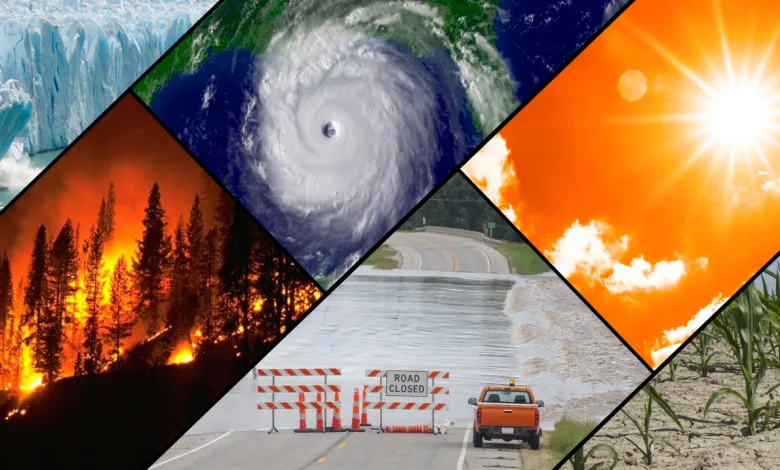
People around the world are already experiencing the consequences, from more intense heatwaves to rising sea levels.
Things are likely to worsen in the coming decades, but scientists argue that urgent action can still avoid the most dangerous effects of climate change.
What is climate change?
Climate is the average weather in a place over many years. Climate change is a shift in those average conditions.
The climate has fluctuated naturally throughout the world’s history.
But scientists say that there is no doubt that the particularly rapid climate change seen over the past century is caused by humans.
In particular they say it is due to the widespread use of fossil fuels – coal, oil and gas – in homes, factories and transport.
When fossil fuels burn, they release greenhouse gases – mostly carbon dioxide (CO2). These gases trap the Sun’s heat in the atmosphere, causing the planet’s temperature to rise.
Over the last 800,000 years, CO2 concentrations in the atmosphere have fluctuated between about 180 and 300 parts per million. Today, CO2 levels are over 420 parts per million and have risen sharply over the last century.
Since the start of the Industrial Revolution – when humans started burning large amounts of these fuels – the amount of CO2 in the atmosphere has risen by over 50%, and is still growing.
As a result of the increase in CO2 and other greenhouse gases like methane, the world is now about 1.1C warmer than it was in the late 19th century.
Change in global temperature compared to the pre-industrial average. Temperatures were around average until about 1950, but have increased since, regularly exceeding 1C of warming in the last decade.
What are the effects of climate change so far?
A global average temperature increase of 1.1C might not sound much, but it has already had a huge effect on the environment. Impacts so far include:
more frequent and intense extreme weather, such as heatwaves, drought and floods
rapid melting of glaciers and ice sheets, contributing to sea level rise
huge declines in Arctic sea ice
ocean warming and marine heatwaves.
People’s lives are already changing as a result. For example, the ongoing East African drought has put more than 20 million people at risk of severe hunger. The 2022 European heatwaves led to an abnormal increase in deaths.
Extreme weather events have caused trillions of dollars of economic damage in recent decades, but the death toll has actually fallen as early warning systems have improved, according to the World Meteorological Organisation.
How will future climate change affect the world?
Scientists say limiting temperature rise to 1.5C is crucial to avoid the most dangerous impacts of climate change – although these increase with every extra increment of warming.
Major changes need to come from governments and businesses, but scientists say small changes from individuals can also make a difference:
take fewer flights
use less energy
improve home insulation and energy efficiency
switch to electric vehicles or live car-free
replace gas central heating with electric systems like heat pumps
eat less red meat.