


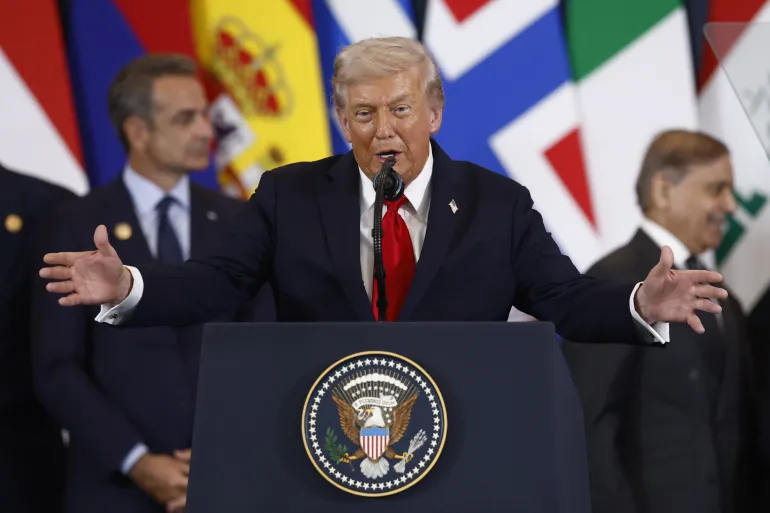
Al-Raqeeb – Political analyst Dr. Mahmoud Kholouf stated that the Sharm El-Sheikh Conference amounted to little more than a symbolic step designed to showcase a political achievement for former U.S. President Donald Trump. He emphasized that the signed document lacks any binding guarantees or real commitments to end the aggression on Gaza.
Speaking to Al-Raqeeb Radio, Kholouf said the international gathering convened merely to declare what was termed a “ceasefire,” without addressing the core of the Palestinian issue or ensuring that aggression would not be repeated. He added:
“We should call it an end to aggression, not a ceasefire, because the West cannot be trusted. Our doctrine is patience, while theirs is betrayal.”
A Different Israeli Escalation and Attempts to Execute Prisoners
Kholouf pointed out that Israel is preparing for “a different kind of escalation,” continuing limited bombardments in Gaza while pushing forward dangerous legislative moves in the Knesset, including attempts to pass laws permitting the execution of Palestinian prisoners involved in the October 7 operation. He described this as “a new slap in the face of the resistance and a blatant challenge to international law,” stressing that the United States provides full cover for such violations.
A Document Without Political Substance or Guarantees
Kholouf further argued that the document signed by the leaders of Egypt, Turkey, and Qatar contains no mention of a two-state solution or clear enforcement mechanisms. Instead, it focuses on issues of “regional integration” and “educational development,” which he said serve to normalize Arab consciousness with Israel’s existence.
“It is a document that speaks of coexistence and peace while ignoring the true source of insecurity in the region—Israel itself,” Kholouf said.
Arab Division and Declining Leadership Role
The analyst also highlighted ongoing Arab divisions that weaken the Palestinian position. He noted the absence of key leaders such as the Emir of Kuwait and Saudi Crown Prince Mohammed bin Salman from the conference, calling it evidence of the decline of meaningful Arab leadership in supporting the Palestinian cause.
Kholouf criticized some Arab states for continuing to “sell their positions” to Israel and the United States through normalization, arguing that such policies ease the pressure on the occupation and undermine Palestinian unity.
A Call for Unity and Ending Political Monopoly
Kholouf concluded by warning that the greatest danger lies in the persistence of internal division and the monopoly of Palestinian decision-making. He underscored the need to rebuild the internal front before entering any new negotiations with international actors.
“For forty years we have repeated the same mistakes, with each side outbidding the other, while our people pay the price in blood, displacement, and destruction,” he said.