


When Israel and Palestine are back in the headlines, one of the most common questions is, what information can I trust?
Which sources are nuanced or unbiased? And who is going to report the realities of the most recent attack? Information surrounding this realm is constantly contested.
People do not know how to engage and are often too scared to voice an opinion. Instead, they will remove themselves from the matter altogether.
This action, perhaps unknowingly, feeds the oppression of the Palestinian people as their occupation continues to go unscrutinised.
“The semantic inequality between Israeli and Palestinian victimisation is clear; Palestinians are simply ‘receivers’ of bullets whilst Israelis are victims of ruthless murderers”
But to understand why the debate is so contentious, the contexts in which information is created must be considered. The centralisation of the British media, for example, where “just three companies dominate 90% of the national newspaper market”, according to the Media Reform Coalition, has contributed to the solidification of a ‘status quo’ or a generally accepted narrative.
In the case of Israel-Palestine, Palestinians are portrayed as barbaric and violent sets of people which, subsequently trickles down through the conglomerates, fostering the media’s ability to manipulate its readers, define a situation, and contort it when it suits their political needs.
On the rare occasion that Palestinians find themselves as speakers in the Western media, they are treated with little compassion and their experiences of genocide and ethnic cleansing are often disregarded.
Journalists who criticise Israel’s regime are faced with false accusations of anti-semitism and silencing tactics, such as being killed. Consequently, we in the West are left with a prevailing discourse that fails to include Palestinian perspectives.
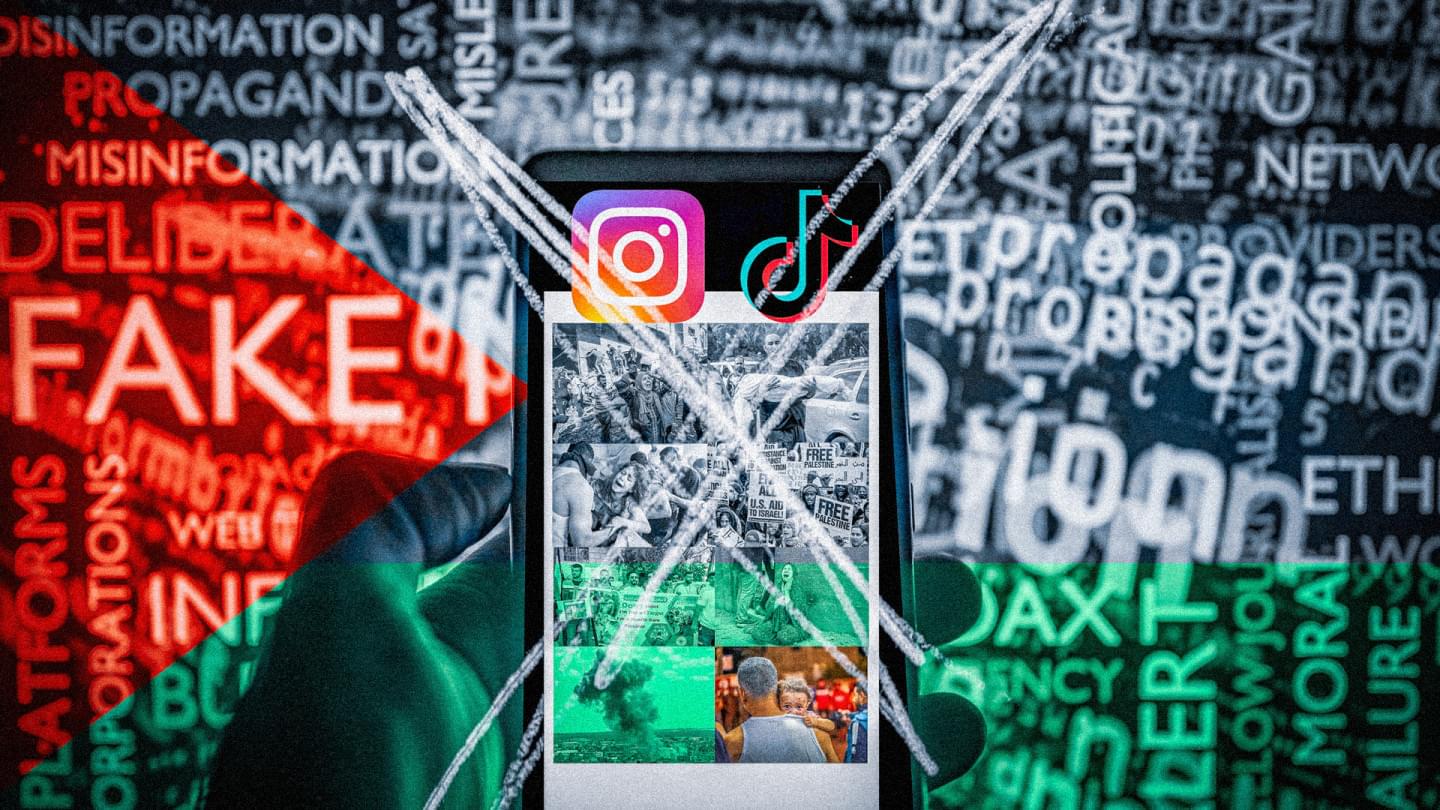
However, complete abstinence from Palestinian experiences, specifically for youths, has become much more difficult, thanks to the power of social media. Whether it is through the re-sharing functions or exploring pages on Instagram and TikTok, the spread of information is rapidly increasing.
Instagram— now the leading news source for 16-24-year-olds in the UK, according to Ofcom — offers a degree of unfiltered opinions and perspectives.
Users have access to voices from all over the world, most importantly, to those directly targeted by oppression.
As a result, accounts such as Let’s Talk Palestine, the IMEU, and Eye On Palestine have been formed in order to educate and show their followers the reality of Palestinian occupation.
This week alone, The IMEU, gained over 130,000 followers and Eye of Palestine an additional one million.
Transparent with their sources, creative autonomy over their content, and employees from Palestine, these accounts have formed an online information landscape combating failed Western journalism.
They are, perhaps, historic game changers in global justice movements. Consequently, the mainstream media’s exclusion of these voices has undermined their credibility and agenda, especially in times of heightened conflict where Palestinian suffering is all over our news feeds.
However, PSEUDONYM, the creator of Let’s Talk Palestine, describes sometimes feeling “drowned out” by the mainstream media.
With 298,000 followers, the platform provides regular updates on the Palestinian occupation, with posts entitled “Israeli Apartheid for Beginners” and “A Dictionary For Israel and Palestine.”
In the first three days of Al Aqsa Flood, despite having “zero money” invested into their account their content reached six million screens. He now predicts these numbers could be as high as 10-15 million.
TikTok, with its unique algorithm, allows influencers to spread messages on a scale disproportionate to their following. Boots On The Ground, who has 167,000 followers recently secured 500,000 views on his post entitled “How stories are framed matters.”
With screenshots of two Guardian headlines in the background the creator, using the duet feature, takes the viewers through the bias, step by step. He highlights the difference in language between “Gaza Strip protesters receive bullet wounds to the ankles” in comparison to “Hamas’s murderous attack.”
The semantic inequality between Israeli and Palestinian victimisation is clear; Palestinians are simply “receivers” of bullets whilst Israelis are victims of ruthless murderers. He warns his viewers to be careful of this framing stating: “The media bears a lot of responsibility in how stories are interpreted.”
“This week alone, The IMEU, gained over 130,000 followers and Eye of Palestine an additional one million”
Social media, which provides a level of anonymity and protection, means Palestinian activists and voices can operate under less threat or control than mainstream journalists.
However, that does not mean they are exempt from being silenced. Twitter, now X, has announced that it has suspended hundreds of “Hamas affiliated” accounts.
But what these accounts look like is yet to be determined. Mariam Barghouti, a well-respected reporter in the West Bank has received threats from Meta saying her Instagram account may be deleted after she posted a video of Hamas with babies.
Barghouti, accused by Meta of praising terrorist attacks and supporting human trafficking, posted in response “Wallah Gaza is being deleted right now.”
Likewise, Mohammed el Kurd, a Palestinian journalist, despite having 797,000 followers on Instagram has received as few as 91,000 views on several Instagram stories.
This silencing technique, known as ‘shadow banning ‘, which limits your content to your followers, is thought to be a form of political interference and is systematically targeting Palestinian content across Meta apps.
Palestinians are now asking followers not to update their Instagram apps due to fears that updates are censoring their truths even further.
7amleh, an organisation that advocates for Palestinian digital rights, states that Palestinian accounts “are censored and over moderated at disproportionately high rates” and are seeing “a higher level today with the escalating events in the Gaza Strip” than ever before.
Just this week they have “manually detected hundreds of cases of Palestinian account restrictions” including the account of British TikTok creator Chris Kunzler.
Kunzler, who reached 5.6 million views in the early days of Al Aqsa Flood, due to his intensely informative content, has been the direct target of the “systematic muzzling” that 7amleh attempts to counteract.
He describes a “clever and coordinated attack” against his account when two of his videos, one of which highlighted a Zionist mistaking Gaza Mozambique for the Gaza Strip, were deleted.
Despite their impressive reach, Let’s Talk Palestine has encountered similar issues. This week, one of their most popular posts, with 100,000 likes, was taken down by Instagram.
Usually, the account handler is notified and given the choice to appeal. But in this circumstance, Let’s Talk Palestine had neither.
Like many others targeted by Meta, PSEUDONYM states, “We are still vulnerable to massive corporations.”
Despite this, Let’s Talk Palestine describes itself as one of the luckier accounts. They are not having to deal with the loss of WiFi and electricity in Gaza.