


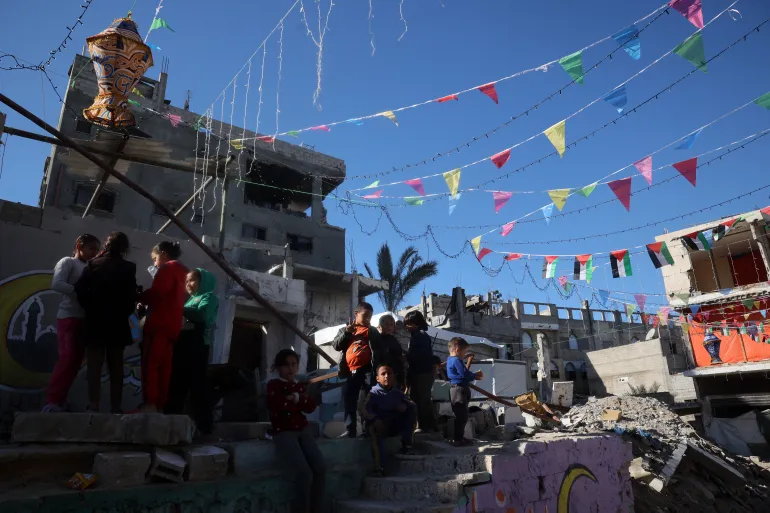
Ramadan has come to devastated Gaza. While the rest of the world embarks with a festive mood on a month of fasting and prayer, we do so with grief and sorrow.
The echoes of war still ring loud. There is no certainty that this ceasefire will last. People are anxious about what happens next. They fear the war may come back.
The memory and trauma of what we have witnessed and experienced over the past year hang heavy in our minds.
Last year was not the first time for us to observe Ramadan during a war. In 2014, I was only nine years old, but I remember very well how our Ramadan nights were filled with air strikes and destruction and how we had to rush out of our home in the dark, fleeing the bombing in our neighbourhood.
But Ramadan last year was different. It was unimaginably worse. Hunger was everywhere. We fasted the entire day, only to break our fast with a can of hummus or beans shared between six people. With no electricity, we would chew the tasteless canned food in the dark. We would barely see each other’s faces across the table.
We were away from most of our extended family. My grandmother, aunts and cousins who I used to spend Ramadan with were all scattered in different places, some displaced in tents and others stuck in the north. The month of togetherness became a month of separation and isolation.
Ramadan was stripped of its joyous spirit. We longed to hear the adhan (call to prayer) at Maghrib before breaking our fast or at Fajr before starting it. But those sounds never came. Every mosque was destroyed. There were people who wanted to do the adhan, but they were afraid – afraid that the sound of their voices would bring air strikes, that it would make them targets.
Instead of breaking our fast to the familiar sound of the muezzin on the loudspeakers of the nearby mosque, we broke it to the terrifying echoes of missiles and gunfire.
Before the war, I used to go with my family to the mosque after iftar to pray and see our loved ones. Afterwards, we would stroll through the streets of Gaza, enjoying the lively Ramadan atmosphere before heading home to have freshly made qatayef.
But last year, there was nowhere we could go to pray tarawih amid the genocide.
Even the Great Omari Mosque – one of Gaza’s most beautiful and historic mosques, where my father and brothers used to spend the final 10 nights of Ramadan, listening to the Quran recited in the most beautiful voices – was gone, bombed into ruins, shattered beyond recognition. The place that once echoed with prayers and peace was turned into dust and rubble.
This year’s Ramadan begins during a ceasefire. There are no air strikes shaking the earth as we break our fast. No explosions reverberating in the silence of Fajr. No fear of decorating our homes, of hanging colourful lights that might make us a target.
Amid the pain and devastation, life – which had been on pause for so long – is trying to come back to Gaza’s streets.
Shops and markets that have not been destroyed have reopened, and street vendors have come back.
Even the big supermarket in Nuseirat, Hyper Mall, has opened its doors once again. Before Ramadan, my father took me and my sister there. We could barely contain our excitement as we stepped into the brightly lit mall. For a moment, it felt like we had gone back in time. The shelves were stocked again, filled with everything we had longed for – different types of chocolates, biscuits and chips. There were Ramadan decorations, lanterns of all shapes and sizes, boxes of dates, colourful dried fruits and Qamar al-Din.
But this abundance is deceptive. Much of what fills the shelves comes on commercial trucks, which make up a large portion of the trucks allowed into Gaza at the expense of humanitarian aid. At the same time, these products have become unaffordable to most people who have lost their livelihoods and homes.
So what will most families break their fast with this year? It will be a bit more than canned beans: A simple meal of rice, molokhia or whatever vegetables they can afford.
For the first iftar, my family will have musakhan, a Palestinian dish that is made from chicken, saj bread and lots of onion. We know we are among the lucky ones. The vast majority of people in Gaza cannot afford the fresh chicken that has reappeared in markets at double the pre-war price.
But a rich, traditional iftar is not the only thing that will be missing from Ramadan tables in Gaza.
More than 48,000 people have been killed during the war. Entire families have been wiped from the civil registry and will not observe Ramadan this year. At so many iftar tables, there will be an empty seat: a father whose voice calling his children to the table will never be heard again, a son whose impatience to break his fast will never be seen again or a mother whose skilled hands will never prepare delicious food again.
I too have lost people I love. My aunt’s husband who used to invite us for iftar each year was brutally killed. My friends Shaima, Lina and Roaa who I used to meet at the mosque after the tarawih prayer were all martyred.
The festive spirit is gone, but the core of Ramadan is here. This month is a chance to step away from distractions and concerns of ordinary life and reconnect with our faith. It is a time of forgiveness. It is a time to seek closeness to God and spiritual resilience.
Our mosques may have been destroyed, but our faith has not been broken. We will still be doing tarawih in half-destroyed homes and tents, whispering all our wishes in dua’a and seeking comfort in reciting the Quran, knowing that Allah will reward us for all the suffering we have endured.
Source: AL JAZEERA