By DANIA ABDELFATTAH
RAMALLAH (Al Raqeeb) – The Palestinian Authority (PA) is bracing for an unprecedented financial crisis in the coming months, following the cessation of European Union (EU) aid and the ongoing Israeli deductions from clearance revenues. This reality deepens the government’s fiscal gap, raising questions about its ability to meet obligations to employees and citizens amidst declining foreign aid and mounting economic pressures. How will the government navigate this crisis, and will it manage to fulfill its financial commitments despite significant challenges?
Mohammad Abu Rub, director of the Government Communication Center, told Al-Raqeeb that the Israeli government’s continued deduction of over 60 percent of monthly clearance revenues—under the pretext of allocations to the families of prisoners, martyrs, and Gaza—has exacerbated the PA’s financial distress.
Abu Rub noted that these deductions, combined with a decline of more than 50 percent in local revenues, have significantly increased financial pressures on the PA. Despite these challenges, the government raised the minimum wage to 3,500 shekels, enabling 70 percent of public employees to receive their full salaries. This decision aims to promote social justice, especially for low-income groups.
Efforts to Address the Crisis
Abu Rub explained that the government is intensifying efforts to secure financial resources by leveraging bank facilities—which have reached approximately $2.7 billion—recovering debts from service-providing companies and mobilizing support from Arab and friendly countries. Additionally, the government is implementing austerity measures under a reform plan to allocate available funds to essential commitments, such as employee salaries and settling debts to hospitals and suppliers. However, details on the value and economic impact of these measures remain undisclosed.
Regarding EU aid, Abu Rub stated that temporary European assistance helped cover some obligations in recent months. However, approval of the new financial support package requires unanimity among EU member states and is expected to be voted on at the beginning of next year. The EU had previously provided emergency financial aid of €400 million ($435.5 million), disbursed in three installments and fully utilized last month.
Challenges in Securing External Support
The PA’s financial struggles have intensified as donor countries have reduced funding, which once covered nearly a third of the $6 billion general budget. These countries have demanded reforms to address corruption and waste. The European Commission announced plans to provide a package of grants and loans to the PA amounting to $2.7 billion over the next two years, contingent upon implementing reforms. However, this package—which may or may not include the previously granted €400 million—requires approval by the European Parliament in the first third of next year. Even if approved, disbursement will take several months, rendering the promised European aid impractical for meeting the PA’s obligations in the near term.
Economic journalist Jaafar Sadaqa explained that a new Israeli law allowing the confiscation of frozen Palestinian tax revenues will further deepen the PA’s financial crisis, complicating its ability to meet commitments to employees and citizens. Sadaqa emphasized that the current financial predicament reflects a deep-rooted political crisis, with the Israeli government aiming to weaken the PA and push it toward collapse. Despite some moves to secure indirect US aid and initiate new projects, these efforts remain limited in impact.
The extension of banking arrangements with Palestinian financial institutions for another year has provided a narrow margin of financial stability but is insufficient amidst ongoing political and economic pressures. Sadaqa stressed that any solutions to the current crisis must be comprehensive, encompassing political, economic, and security dimensions, as partial agreements have proven ineffective.
A Looming Fiscal Cliff
Economic journalist Mohammad Rajoub highlighted that the PA could face even greater financial challenges in the next six months, especially with the suspension of EU aid, which is unlikely to resume until early next year. Rajoub predicted that the government would restructure its collective loan from banks at the end of 2023 to raise additional funds, enabling it to continue paying 70 percent of public employees’ salaries. This approach could benefit both the government and banks, as the latter could continue deducting loan installments from employees’ salaries, ensuring financial continuity.
However, Abu al-Rub pointed out that the collective loans that previous governments resorted to in order to cover their obligations still constitute a great pressure on the current general budget, which limits the government’s ability to achieve financial sustainability. This difficult financial reality places the authority before limited options that require enhancing efforts to support the treasury with resources and rationalize expenditures in order to alleviate the severity of the crisis and ensure the continued provision of basic services and fulfill its obligations towards employees and suppliers.
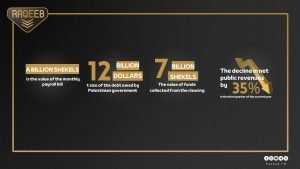
The Ministry of Finance data showed a sharp decline in net public revenues by 35 percent (on a cash basis) for the third consecutive quarter of the current year 2024.
According to the data, net public revenues for 2024 amounted to about 8.4 billion shekels, in the period January-September, 2024, while it reached 13 billion shekels for 2023 in the same period.
It indicated that the financial gap is widening between the size of public revenues and the amounts needed to finance public expenditures, which increases the size of the financial deficit of the Palestinian government.
Interest on public debt service increased, reaching about 318 million shekels for the year 2024, compared to 164 million shekels for the previous year.
The total public debt amounted to about $12 billion, of which the Palestinian government’s debt to public employees due to reduced salaries amounted to about $1.345 billion until the end of September, 2024.
The Palestinian government’s debt to local banks also amounted to about $2.791 billion for the current year. The government’s debt to the Palestinian private sector accumulated and reached about $1.490 billion, and the Palestinian health sector constituted 60 percent of the debt to the private sector.
The external debt amounted to about $1.333 billion.
The figures issued by the Ministry of Finance show that the total clearance funds that the occupation withholds from Palestinian tax revenues and refuses to return them amounted to about 7 billion shekels, from 2019 until October 2024.
Fact box:
- $12 billion: Total public debt of the Palestinian Authority.
- $1.4 billion: Debt to public employees.
- $2.8 billion: Debt to local banks.
- $1.5 billion: Debt to the private sector.
- $1.4 billion: External debt.
- $4.9 billion: Debt to pension funds and others.
- 1 billion shekels: Monthly salary bill.
- 35%: Decline in public revenues in Q3 2024.
- 7 billion shekels: Withheld clearance revenues.